How Do I Know If My Pool Cage Needs Structural Repair?
 CALL NOW
Most Tampa Bay homeowners can't tell whether their pool cage problem is cosmetic or structural — and that's reasonable, because the visible symptoms often look the same. This guide gives you a 7-test walkthrough you can do yourself in 15 minutes, then explains when each result means "call a rescreener" vs. "call a structural contractor."
Why This Matters
The wrong diagnosis costs money two ways. Calling a rescreener for a structural problem gets you a $400 fix that doesn't solve the actual issue — the same problem returns within a year, sometimes worse. Calling a structural contractor for a cosmetic screen problem gets you an $1,800 quote for work you don't need. Neither is good. The fix is knowing which one you actually have.
The 7-Test Walkthrough
Set aside 15 minutes. Walk your pool cage with a notebook or your phone, and go through these tests in order.
Test 1: Look at the Uprights — Are They Plumb?
Stand at the corner of your pool cage and look down the vertical aluminum upright. It should be perfectly vertical from top to bottom. Walk to each upright in the cage and do the same. If any upright visibly leans (more than a few degrees from vertical), you have structural damage. Bent uprights happen from wind load, falling debris, or footer separation, and they don't fix themselves.
Result: Lean visible → structural repair needed.
Test 2: Look at the Top Beams — Are They Straight?
Step back and look at the horizontal top beams of your cage from a distance. They should be straight from corner to corner. If any beam visibly bows downward, sags toward the middle, or dips at one end, the beam has lost structural integrity. This is most common on the back-wall beam (the one facing your pool from the house side).
Result: Bow or sag visible → structural repair needed.
Test 3: Check the Corners — Are the Connections Tight?
Walk to each corner of the cage and look at where two aluminum sections join. The connection should be flush with no visible gap. If you see daylight between sections, screws sticking out, or brackets cracked or missing, that connection has failed. Multiple failed connections is a structural emergency — they cascade.
Result: Gaps or sticking screws → structural repair needed.
Test 4: Check the Footers — Is the Cage Anchored?
Walk the full perimeter of the cage and look at where the aluminum meets the concrete deck. Every footer point should be flush with the deck — no daylight, no concrete cracks at the anchor, no rust streaks coming out from under the aluminum. Tug gently on a few uprights at the base. They should be rock solid. If anything moves, the anchoring failed.
Result: Daylight at footers, or any upright moves → structural repair needed.
Test 5: Check the Screens — Are They Tight?
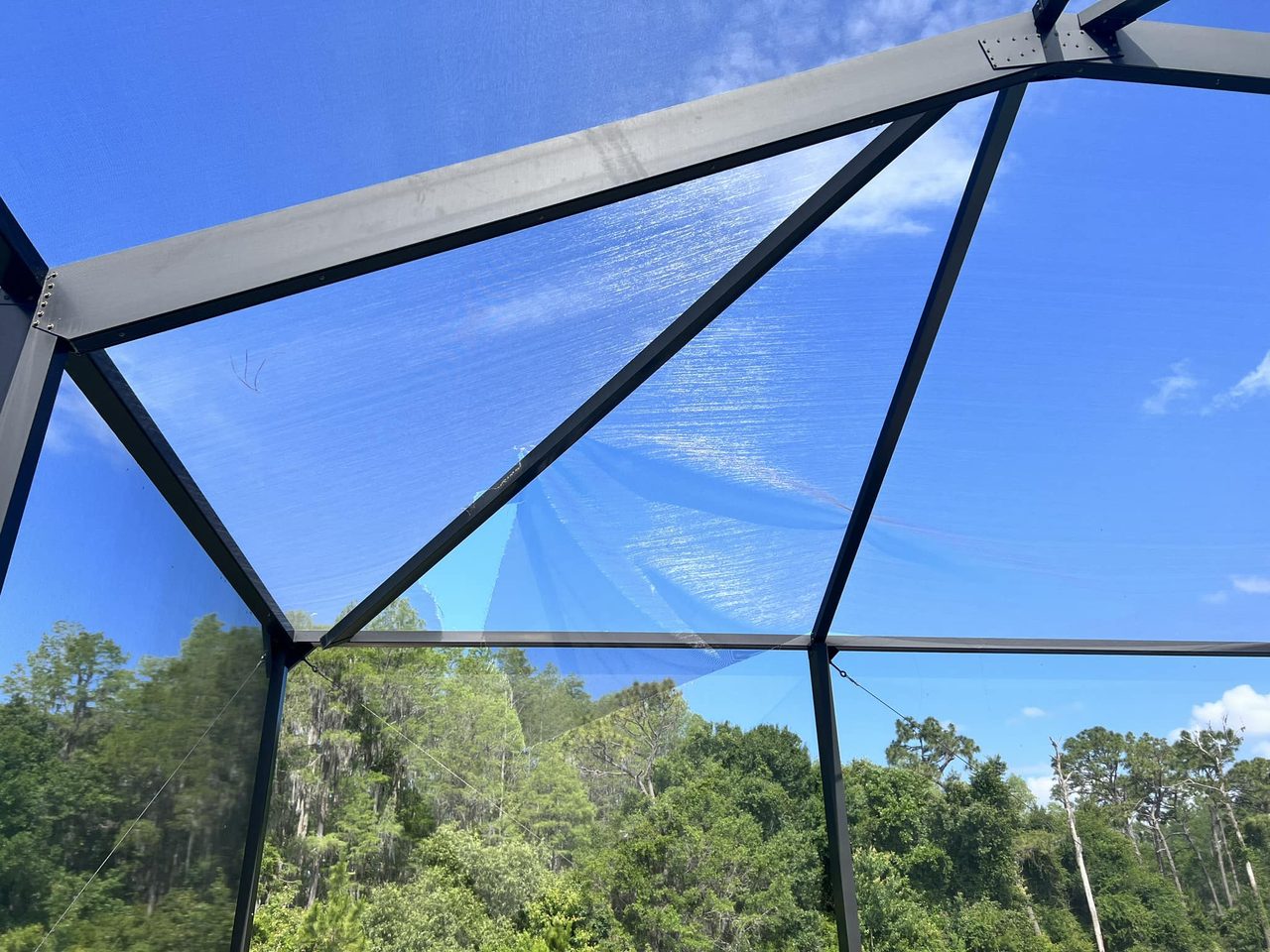
Push gently on a screen panel (not a torn one — an intact one). It should be taut and spring back. If the screen is loose, wrinkled, or you can push it inward more than an inch or so, the screen has lost tension. This could be from screen age (cosmetic) OR from frame distortion (structural). The next test distinguishes them.
Test 6: Did the Cage Recently Get Rescreened?
If your cage was rescreened in the last 12 months and the new screen is already loose, the problem is almost certainly frame distortion — the frame can't tension the screen properly because it has shifted. This is structural. If the cage hasn't been rescreened in 8+ years and the screen is loose, the screen has UV-degraded — that's cosmetic and rescreening will fix it.
Result: Recently rescreened + loose screen → structural. Old screen + loose → cosmetic (rescreen).
Test 7: Look at the Aluminum Itself
Get close to the aluminum and look for:
- Surface staining (orange or brown): usually cosmetic, can be cleaned
- Active flaking corrosion: structural — metal has degraded
- Visible pitting (small craters in the metal): structural — typically coastal salt-air damage
- Cracks in the aluminum itself (not just paint): structural emergency
Scoring Your Results
If you found any of the following, you need a structural assessment:
- Any bent or leaning upright
- Any bowing or sagging beam
- Any gaps at corner connections or sticking screws
- Any footer daylight or footer movement
- Recently rescreened cage with loose screen
- Visible aluminum pitting, cracks, or active flaking corrosion
If none of the above and only:
- Torn or holed screen panels
- Old screen that's gone loose
- Surface staining (no flaking)
- Cosmetic paint fade
...then you have a cosmetic problem. Call a rescreening company. The fix is in the $400–$900 range.
The Edge Case: Storm-Damaged Cages
If your cage took damage in Helene, Milton, or any major storm event, the assumption should be structural until proven cosmetic. Storm damage frequently produces frame distortion that's not visible from a distance but is detectable on close inspection. We've worked dozens of "looks fine from the patio" cages that turned out to have hidden structural issues from 2024 storms.
If you took any storm damage and aren't 100% sure your cage is structurally sound, get an assessment. See our hurricane damage page for the post-storm walkthrough.
When to Skip the Self-Test and Just Call
Call for an assessment without doing the walkthrough if any of these are true:
- Your cage is 25+ years old (likely in the structural fatigue window)
- You took any kind of storm damage in the last 18 months
- You can see obvious structural issues from the patio without going close (collapse, severe lean, large gaps)
- You have an insurance claim filed or considering filing one — assessments matter here
- You've had rescreening done but the screen keeps going loose
What an Assessment Costs
Our structural assessments are free. On-site inspection, written report, photos, repair-or-replace recommendation with itemized pricing. We don't take rescreen-only jobs so we have no reason to inflate the scope — if your problem is cosmetic, we'll tell you.
Call (813) 485-6204 or fill out the form to schedule. See also our full structural damage guide for more detail on each warning sign.
CALL NOW